14 Sep, 2026
Art Nouveau And The Vienna Secession Reinterpreted
Interior designer Yana Molodykh was enlisted to breathe new life into a 1,637-square-foot home for a family of four—a successful restaurateur a prominent layer, and their daughter and son who attend school just steps away. Located in the heart of Vienna within the modern Ambassy Parkside Living complex, the apartment boasts high ceilings and panoramic windows that invite the spirit of the Austrian capital indoors. To soften the building’s sharp angles, Molodykh introduced curved forms to create a seamless, flowing spatial experience.“In Art Nouveau, lines flow smoothly and continuously, without a defined beginning or end,” she says. “I embraced that organic approach, allowing lines to wrap around the space like a ribbon.”
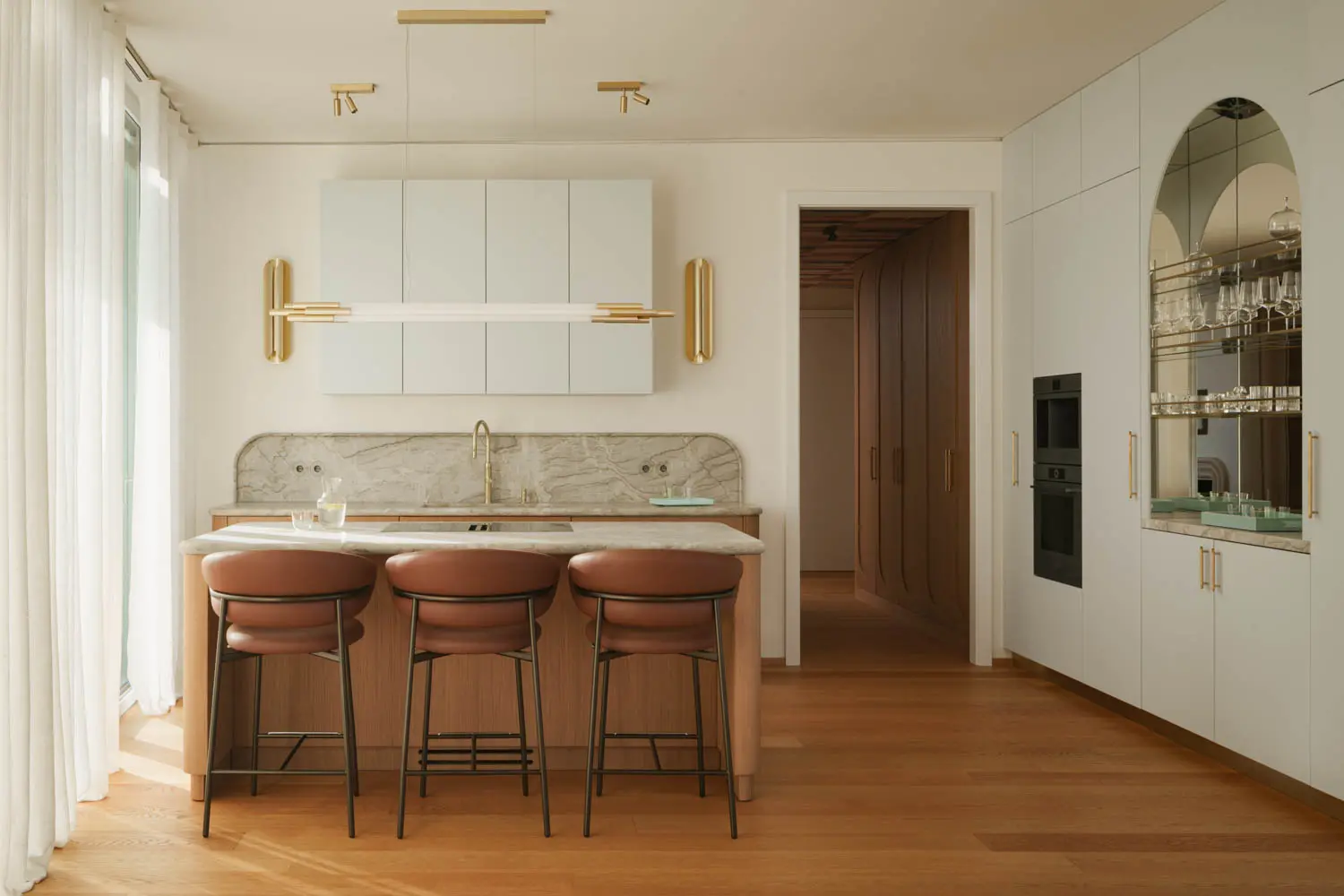
Bespoke furniture and tailored details define every corner, from the study cabinetry to the entry storage units with dedicated modules for each family member. In the kitchen, bold-veined White Tiger quartzite takes center stage, paired with a niche that reflects an iconic Lobmeyr crystal piece. “The warm glow of brass and the brilliance of glass create an aesthetic that is timeless, refined, and harmonious,” says Molodykh. In the living room, a vintage illustration of a blue-green stag beetle—sourced at a local antique bookstore—adorns a space designed to celebrate it unique layout. To navigate the room’s irregular angles, Molodykh used curved forms for a sense of effortless fluidity. To complement the existing oak parquet, the interior designer worked with the experts at YourFoResta who developed around 15 different ash veneer staining options to find the perfect match.
What makes this home even more captivating is how it reimagines the Vienna Secession for modern living. Here, every element—from the furniture to the walls—is treated as a total work of art (Gesamtkunstwerk), serving as an homage to the revolutionary late-19th-century movement spearheaded by icons like Josef Hoffmann, Otto Wagner, and Gustav Klimt. “The challenge—and the joy—was to capture Vienna’s distinctive atmosphere and rich historical heritage, subtly weaving it into the interior,” concludes Molodykh.
 Promote Architects & Construction